Research Statement
My research, building from my completed dissertation titled “Beauty and the Beasts: Making Places with Literary Animals of Florida,” seeks to inspire environmental advocacy in the literature classroom through the study of Florida stories featuring nonhuman animals who serve central roles. Place theory examines the relationship between human identity and physical locations, asking how meaningful attachments are formed between people and the spots they visit or in which they live. Literature of place exhibits this relationship and the myriad ways humans connect to their environment through storytelling, both fictional and nonfictional. Florida literature, an emerging and dynamic genre, features characters, cultures, and histories heavily embedded in place. Florida’s places also abound with animal presences, and literature about Florida almost always illustrates significant human-animal interactions that drive plots and character development. Therefore, Florida literature invites consideration of how animals influence human attachment to the land in stories written by Florida authors. Scholarly attention has noted the important relationships formed by humans and animals in literature about Florida, but no extensive study incorporating place theory, ecocriticism, and close reading has been done on the literary representation of Florida animals or their contribution to the state’s diverse reputations.
My research brings together theories about place attachment, ecocriticism, and critical animal studies (CAS) to illustrate the roles of fictional and nonfictional animals. My focus began with six Florida authors: William Bartram, Marjory Stoneman Douglas, Marjorie Kinnan Rawlings, Elizabeth Bishop, Rachel Carson, and John Henry Fleming. Their works contain prominent animal characters that illuminate four ways of seeing Florida: idyllic Florida, wild Florida, opportunistic Florida, and mysterious Florida. These identities build off historical views about Florida as place: explorers, tourists, and developers projected their hopes for advancement onto the state based on its reputation as an exotic paradise, wild hinterland, or untouched beacon for industry and agriculture. Literature helped to produce these ideas about Florida through travel writing, but Florida stories also critique opportunistic ideologies responsible for harming animals and the environment. Literature can also preserve Florida’s mysteries and myths, offering narratives about nature and animals that challenge notions of human superiority. Thus, literature enacts a dynamic engagement with the four faces of Florida I discuss.
Florida animals are vital to the construction of these four identities. For example, Henry Bunk, the protagonist of Douglas’s Alligator Crossings, sees the Everglades as an idyllic alternative to the city for its many birds and fish. Rawlings depicts Cross Creek as a wild host to deadly snakes, predatory big cats, and ubiquitous insects. Bishop captures through poetry the ordinary activity of Florida fishing in such a way that invites us to question the harm inflicted on animals for the opportunity of recreation. Fleming’s stories suggest that exploration, industry, and science have mostly erased the mysteries of Florida’s natural world, but his enigmatic and monstrous animals, along with their ties to the land, offer hope for reviving a meaningful attachment to the land.
Most importantly for my ongoing research, many works of Florida literature represent animals and animal themes based on real forms of violence occurring in Florida today, including fishing, caged hunting, and animal captivity. My research explores how we as teachers can use this interplay between fiction and reality to spark, at the least, curiosity about the Florida environment, and at most, active participation in defending nature and animals. How can we prompt readers to rethink their own relationships to place and to nonhuman nature? As a cultural force, literature holds the potential for effecting change in our world. Beginning with the local is one way of witnessing this potential for real, positive ecological impacts from an English classroom.
My dissertation did not explore a potentially crucial aspect of how animals are portrayed in literature and other artforms, including popular culture. One tenet of place theory is that experiencing a place (physically or by reading or hearing about it) can pique our curiosity about it and inspire us to protect it. How this happens is less clear. Psychology has long highlighted self-interest as a prime motivator, and self-interest is necessarily linked to identity. What aspects of a person’s identity and their understandings of other identities influence the desire to act on behalf of nonhuman nature? Race, class, gender, sexuality, religion, nationality, age, and ability are critical to identity. An author’s demographics and life experiences inevitably shape their portrayal of human and nonhuman characters. What do representations of Florida animals reveal about race, class, and gender? How does an ecofeminist lens—which recognizes how women have been animalized and dominated in similar fashion as the environment—enrich the connections I make between animals, place attachment, and the various modes of Florida depicted in literature? How can we teach Florida literature so that students ultimately see facets of themselves and their histories inscribed in animal characters and the Florida environment? And finally, can seeing themselves in Florida stories contribute to our students’ ecological ethic?
For an example of using an ecofeminist approach to inspire environmental advocacy, I turn to Cristina García’s The Aguero Sisters, a Cuba/Florida novel in which renowned ornithologist Ignacio Agüero murders his wife Blanca while pursuing a dwindling bird species in the Zapata Swamp. Throughout their relationship—indeed, beginning from their first encounters—Ignacio compares Blanca to birds. Ignacio even applies his scientific justification for killing birds to the murder of Blanca, revealing a destructive land ethic through his attempt to master both female and animal nature. However, the novel offers a positive view of the connection between women and nature in Reina Agüero, who both defies gender norms and brings the truth about her mother’s death to light.
On the surface, this novel isn’t about environmental stewardship, but I argue that it can be used to inspire students to care about nature and animals without polluting García’s purpose. Because Florida literature is never strictly fictional, students may easily recognize certain historical events or aspects of their personal histories in the narratives. Women students, (especially those for whom race intersects with their oppression as women) may resonate with the threat of Ignacio, who increasingly sees his wife as irrational, wild, and difficult to control, and therefore commits violence against her. Outside the classroom, this identification with both human and nonhuman characters can make students see nature—birds and swampland, in this case—in new and productive ways.
Race, class, and gender intersect with animality in the writings of several additional Florida authors, such as Zora Neale Hurston, Ernest Hemingway, Campbell McGrath, George E. Merrick, Carl Hiaasen, and Stephen Crane. My research seeks to synthesize analyses of these authors with those I have produced on Rawlings, Fleming, Bishop, Bartram, Douglas, and Carson through an ecofeminist approach, one that recognizes the hegemonic animalization of women, people of color, and the working class to achieve patriarchal domination over those demographics. Studying facets of personal identities as they appear in Florida literature and linking them to the land can invite meaningful discussion of our students’ existing impacts on the environment and how to improve those impacts in the time they spend outside of our classrooms.
Jose Yglesias and Ybor City
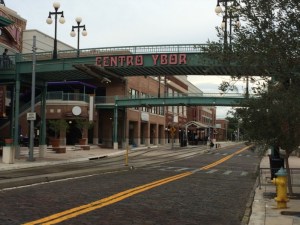
One research project project In the fall of 2014, I joined three colleagues on a research project for Dr. Laura Runge’s Literature of Place: Florida course (view my ePortfolio here). Dr. Runge sought to enrich her students’ understanding and experience of Florida by showing how literature and place construction interact. One of her pedagogical strategies included field trips to the sites we read about, including Ybor City, the setting of Jose Yglesias’s 1999 novel The Truth About Them. My classmates and I explored the Ybor City Museum State Park and then enjoyed a guided tour of the casita and courtyard. Yglesias illustrates the boom of the cigar industry and the early development of Tampa’s Ybor City as a center for immigrant families, especially of Cuban and Spanish descent. Through the fictionalized narrative account of Pini, layered in many instances with Yglesias’s own rich past, readers begin to get a sense of Ybor City’s complex history.
In “The Radical Latino Island in the South,” Yglesias reflects on the contributions of Cuban, Spanish, and Sicilian immigrants to the development of Ybor City. He discusses various social clubs, such as the Centro Asturiano, the multiple cigar factory strikes, and the impact of the Cuban revolution on Ybor’s cigar industry. For Yglesias, “Ybor City is not a place where time has stood still, but a town ravaged by time and lost social struggles. This doesn’t mean there is nothing to celebrate about the special contributions this Latino community has made to Floridian and Cuban history—indeed, there are many more than the article suggests—but if it was inevitable that its special ambiente die out, the truth about it must not.”
Interestingly, while the Ybor City State Park Museum has preserved the influence of the cigar workers and their families on the creation of Ybor as a Place, Yglesias and his writings have nearly been forgotten. Copies of his novels are scarce in the Tampa Bay area, and the Ybor City Museum features no exhibit on this significant local author. Therefore, one of the most important histories of Ybor City remains unknown by its own community. Our collaborative project sought to change that.
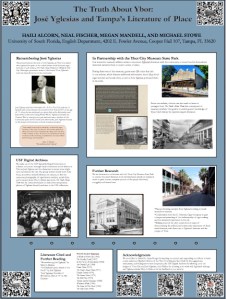
Working with the Ybor City Museum State Park, my classmates and I created an interactive museum display that allows visitors to scan QR codes linked to our website, a comprehensive digital resource for learning about Yglesias, his writings, and his contribution to Ybor City’s history. Our website also features passages from The Truth About Them that correspond to the museum exhibits; these excerpts are available to read from the site or to experience audibly, read aloud by our group members. View our website here.
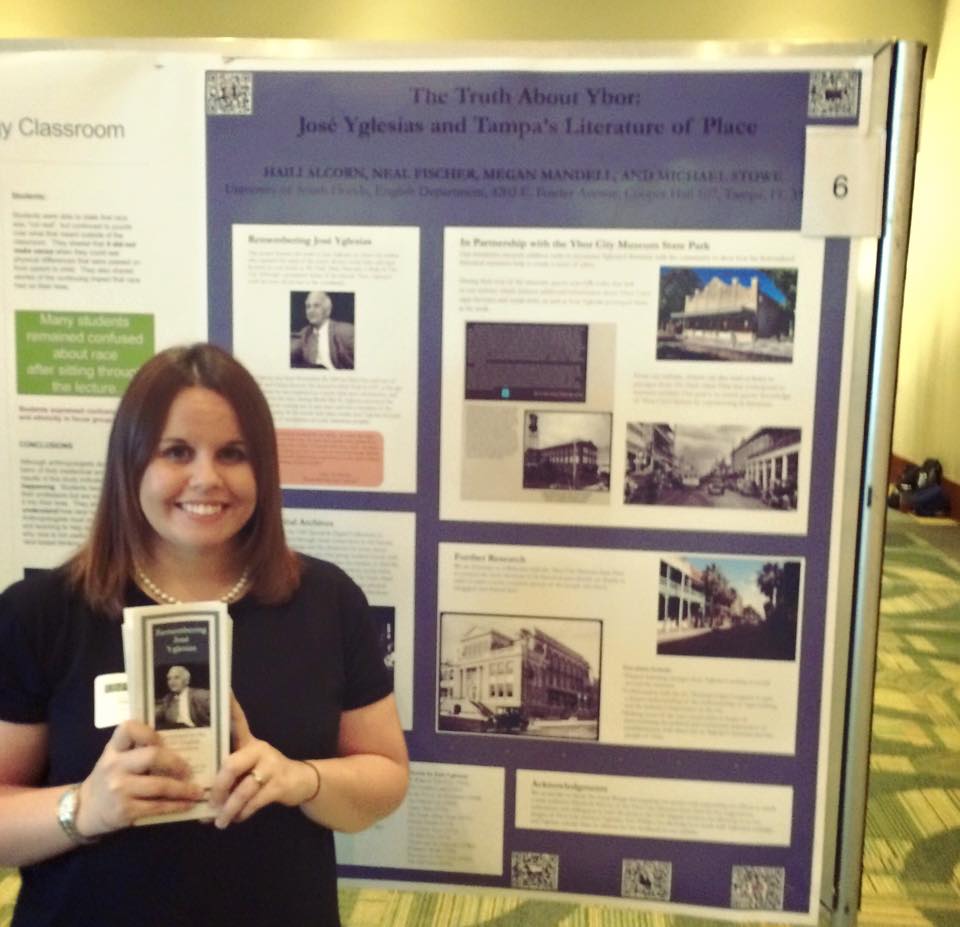
Our work has garnered much recognition, beginning with acceptances to two research colloquiums at USF: the Science, Technology, Engineering, Arts, and Math (STEAM) Conference and the Seventh Annual Graduate Research Symposium, both held in March of 2015. We created a poster for these events, pictured left. Our project won an award for the Humanities category at the Graduate Research Symposium, earning us $500 in travel funds to present at future conferences. Even more exciting, we spoke with Jose Yglesias’ grandson Matthew and were contacted by Yglesias’ son Rafael, the very inspiration for Rafael in The Truth About Them. He calls our work “gratifying,” as his father’s writing “is woefully neglected everywhere but especially in Tampa.” Needless to say, we were thrilled to be communicating with essentially a character we had read in a book; it gave our efforts the sense of having come full circle.
 haili alcorn, Ph.D.